Marketing and Sales

Internet Marketing tips and sales copywriting advice from Chris Garrett to help you launch your products, generate more quality leads, and convert more visitors into long term, loyal customers.

  • How to Attract Clients and Fill Your Coaching Practice Using Blogging and Content Marketing

    Today I want to give you some ideas for how you can attract clients and fill your coaching practice using blogging and content marketing. If you would like some background on why I believe coaching is a fantastic service to offer in your business, check out the previous article. First Big Mistake Before we get…

  • Are You Ready for Social Media?

    The online marketing world moves in waves, with the majority of businesses following a trend not because it is fashionable but out of commercial necessity.

    • Going online, just to be online.
    • SEO was king for many years.
    • Then it was Adwords.
    • Blogging came next.
    • Now it is Social Media that is gaining all the attention.

    In the past competitiveness and innovation played the largest part, but I have no doubt worries about the global economy are driving the most recent moves.

    Although Social Media has been growing steadily for a few years, it seems now most businesses are looking towards these tools and services to find a good ROI alternative to their offline marketing, without the heavy prices that Adwords require in many niches.

    Is Social Media the solution that you are looking for?

    Why Social Media?

    There are many advantages to social media over and above just “Traffic”:

    • Modern version of traditional PR.
    • Speed up your reaction times.
    • Super-efficient word of mouth marketing.
    • World wide focus group.
    • Instant answers to business or technical questions.
    • Brand awareness.
    • Be on top of market news and moves.
    • Grow your network.

    There are also valuable indirect benefits. Attention creates the opportunity for links and traffic, which drives search rankings, which in turn will attract people who want what you offer. Buzz does not need to be the end you strive for, but can also be a means to an end.

    But there are also pitfalls:

    • Social Media can spread bad news too.
    • Pitch and promote approach will meet with resistance. Traffic to direct offers seldom convert well, you need to find a new way to bring attention to your products and services.
    • The chit-chat aspect can be addictive. Use Twitter best practices.
    • This stuff takes time and experimentation.

    What to Do?

    We are still at the beginning with these tools, there are no rules. The best social media strategies for each type of organization or individual are still being developed. There are though guidelines that you can use to make sure you get the most out of all this social media stuff:

    1. Have a purpose, direct your efforts. Unguided meandering will just cause you to get bogged down.
    2. Give before expecting anything in return. The most generous, genuine and valuable are those who’s ideas spread best.
    3. Monitor your reputation. Use tools like TweetDeck, Google Alerts and Twitter Searches to see who is talking about your brand keywords and why. Respond appropriately.
    4. Measure your ROI and do more of what works.
    5. Experiment. Keep learning from case studies and good examples.

    As always, I recommend you link all your social media activity back to your blog or website. Bring people back home, and give them good reasons to stick around. Build up your own base of loyal and egaged advocates.

    Whatever you do, do not abandon what has been working for you and is still providing returns. Find ways to integrate the new stuff rather than throw out good tactics just because the new stuff is, well, new.

    • Create valuable content and optimize for search engines.
    • Engage your subscribers and customers.
    • Grow your links and referrals.
    • Build your lists.

    Survey

    Mike Stelzner is running a Social Media Survey and I am really looking forward to the results. If you take part you can get the results too. Take the survey here.

  • How to Grow Both Twitter Followers and Your Blog Subscribers

    Check your Twitter Follower Count and compare it against your Blog Subscriber Count. Which is the bigger number? Which of those counts is growing faster?

    I asked my Twitter followers this question, and overwhelmingly the answer came back that you have more Twitter followers or Twitter is catching up fast and likely to overtake.

    The folks who have far fewer Twitter followers than blog subscribers are those who I would call “Well Established”. Their audience has been subscribed for a long while and in large numbers, while their Twitter following is recent and likely made up of a subset of their huge blog or email list audience. Uber bloggers like Darren Rowse and Brian Clark come to mind, and internet marketers who can call on hundreds of thousands of email subscribers like Frank Kern, Jeff Walker, and Rich Schefren.

    Why is Twitter Overtaking Blog Subscriber Count?

    In the case of Twitter dominating, I believe this is down to the relative ease of recruiting followers and the method in which it happens.

    Twitter is like blogging but accelerated and concentrated. Rather than links, comments and trackbacks, we discover new people to follow through replies, both to you and to others. If someone replies to me with an interesting comment, or if someone I am following has an interesting conversation with someone I haven’t discovered, I am more likely to follow them. People who would otherwise go unnoticed in the blogosphere have found attention far more efficiently in the Twittersphere.

    This is even more pronounced when you get noticed by the Twitter movers and shakers. As in the blog world where an A-List link can boost your subscriber count, this happens much more often on Twitter. Tweets are cheap, it isn’t a big deal to fire off a message, compared to writing up a blog post, so a conversation with a big named Tweeter can drive hundreds of follows with little effort or risk on either side.

    There is also the “reciprocal follow” where someone follows you so you follow them back. It doesn’t happen all the time but it is virtually unheard of in blogging.

    In the case of personal blogging, Twitter has mostly taken a big chunk of the action. Before we would subscribe to the feed of people we wanted to stay in touch with. Family, friends, or just people who we found interesting. Twitter now provides the same role, with the bonus of immediacy of updates and instant interaction.

    The End of the Blog Feed?

    There is much to be said for the blog, or email newsletters. Not least is depth and detail that is not possible in 140 characters. But that in itself could be seen as a disadvantage as reading more than a few sentences feels like “effort”. Writing a few hundred words even more so. 140 characters means “just the facts”.

    Blogs will more and more have to provide value greater than mere links, quips and trivialities. The chit-chat conversation has moved, and your content and community will need to evolve. Discussions on blogs will need to take more thought and provide more value.

    What Should We Learn?

    People with large, established audiences, can add many more Twitter followers just by pointing out their Twitter Feed, but to move their audience to follow in quantity will require the promise of something over and above business as usual. That requires interaction and original content. Not everyone will have the time or see the benefit, so we are unlikely to see 1:1 matches across the board, however those that do engage will benefit from viral effects and social audience growth.

    Chris Brogan is the reverse of the big-blogger stereotype. While obviously being an established blogger pre-Twitter, it was social media and Twitter especially that cemented his popularity and profile, and therefore I see his Twitter following fueling his blog subscriber count growth through fantastic content promoted via cleverly tweeted links. The lesson here is your Twitter Feed can grow your blog if you model successful Tweeters like Chris B.

    Either way, you need to:

    • Provide unique value in both Twitter and Blog.
    • Drive followers to your sites with carefully crafted and selected links.
    • Encourage subscribers to engage you in conversation in Twitter.
    • Be aware of the strengths and weaknesses of both.
    • Continue to observe those who are gaining traction and learn from their example.

    What Do You Think?

    Are you seeing this phenomenon? Have your own theories? Please share your thoughts in the comments, or of course, on Twitter ;)

  • Email Marketing Tips: What to Write About

    Email Marketing Tutorial

    The most common question I have been sent lately about this series has been

    I know I need a list but what do I send? What should I write about? How can I get people to buy?

    An email list is just a delivery mechanism. What you send to people is up to you. That is both a liberating and scary thing, because it is a blank canvas, but a very public one.

    Put yourself in the role of the subscriber. What do they expect from you? Why did they enter their email address? When you put your subscription form up there you are making a promise, so deliver on that promise!

    First, Content

    Above all else you should provide useful, valuable content. It stands to reason that if people are not gaining by being on your list then they will leave it.

    Should it be unique and different to your blog content? In my case subscribers get the same content as my feed readers, but with additional downloads or emails that don’t appear anywhere else.

    There is no rule that you have to follow that route necessarily, you could use your blog content but packaged differently. For example you can do a weekly roundup, or highlight the best articles from the week.

    Random alerts are another solution. Michael is sending very short emails about links he has discovered.

    Another popular choice is the email course or sequence, where you sign up and get several pre-written emails in a row about a certain topic, delivered by your auto responder software. Sonia has a 10 part marketing course, but you could write one on anything, how about “Ten Tasty Tips About Broccoli“?

    Sell Stuff With Email

    The key to selling stuff with your email list is to make what you offer also content.

    Take the role of an editor, or connoisseur, you are providing your list subscribers the choicest, best, ideal selections. Even better, make the email worthwhile even should someone not buy, so everyone gains. You can introduce products as part of a tip, solution or piece of advice, or as further reading.

    In general you want to be following the 80-20% rule, where 4 out of 5 emails should be pure content, and only one promotional. You can still often get away with a “footer” that links to your products and services though.

    Summary

    The golden rule of email marketing is to TEST – watch the reaction to everything you do:

    1. Incentives
    2. List building efforts
    3. Frequency
    4. Subject lines
    5. Content
    6. Offers
    7. Click throughs
    8. Unsubscribe reasons
    9. … everything else!

    Your subscribers will tell you what you get right and wrong, listen to them!

    That’s the end of this series but look out for more email marketing tips right here in future.

    Got any questions about email marketing? Let me know in the comments and I will do my best to answer :)

  • Email Marketing Tips: Writing Effective Email Subject Lines

    Email Marketing Tutorial

    In the last article of this Email Marketing tutorial series we looked at email copywriting and the goal of each element of your emails. We also looked at the importance of your subject lines in getting your emails opened. Let’s look at this aspect in detail.

    As previously discussed, your email subject line has one main priority; get the recipient to open the email.

    A Word of Warning

    First of all, we have to keep in mind the risk of being flagged as spam.

    While there are plenty of ways you can ratchet up the impact of your subject lines, balance this impulse by remembering you want to maintain the long term value of your list.

    What do spam emails look like? Just look in your spam folder. They shout, they use lots of dollar signs, excessive punctuation, and tend to be, well, needy. Having said that, you can learn a lot from the good spams, there is a reason why spam continues … it makes money, so some of this has to be down to copywriting and not just sheer quantity.

    Keep your email subjects familiar and consistent also, start with the same words so the recipients recognize you. I tend to start with the name of the newsletter. You are better off starting with the name of the newsletter because a lot of email clients will chop off the words at the end for space reasons.

    Now, some of you will be thinking “Hey, there is no need – the recipient gets my email address”, which is true if you send your emails from “XXX Newsletter” but a lot of people don’t have a special email account for your newsletter. For example I like people to reply to the emails I send out so I send them out from me. Also, a lot of times email software shows the email address, not a friendly name, or the recipient only looks down the subject lines. My advice, as always, is do your own testing.

    Optimal Email Subject Line Lengths

    “How long should my email subject line be?” is the next question we need to cover. I get asked this a lot, and my answer is always “Long enough but not too long” :)

    The maximum subject line length will be enforced by your software, but always try to keep it below 50 characters (including punctuation and spaces), because after that you are almost guaranteed to get cropped by email clients. Personally I aim for much lower, a goal of 20-30 characters has worked well in my testing, and certainly those with below 30-40 characters perform much better than those above …

    That said, I do NOT rigidly stick to this. It’s important to get your point across clearly, and if that takes a few extra characters, so be it. I refer again to my point above about long term value. Your emails have to make sense.

    Writing Compelling Email Subject Lines

    The trick to writing email subject lines that get your messages opened is to appeal to the recipients emotions, needs and curiosity.

    Consider your own behavior. When you are going through your inbox, what are your thought processes? You open emails based on the five Ć¢ā‚¬ĖœI’s …

    1. Importance – If it is work-related, or a PayPal payment, you are going to open that email smartish
    2. Intrigue – Curiosity, like a good joke or riddle, causes you to open the email to see what the punch line is.
    3. Interest – We all have subjects that we love to read about, so sometimes all you have to communicate is the topic
    4. Involvement – Pull on the heart strings, appeal to passion, greed, narcissism or any other emotional hot button
    5. Investment – Recipients will be personally or financially invested in something. Craft your subject line around it and it will get opened.

    So how do you put that into practice?

    • News – Tell your recipients what’s new, something that is happening or just happened that they will want to know about
    • Tips – “How to” is a great way to get your email opened, providing you connect your solution to the recipients needs
    • Offer – Make a compelling offer that the recipient will want to take up
    • Question – Ask a question that the reader will answer “yes” to, or maybe put the subject in the form of a mystery or puzzle where the they will feel compelled to find out the answer.

    You can mix and match, of course. Consider the headline “Who else wants to learn how a librarian made $1,000 in one day?”. It’s a question, a how-to, and it is news.

    The Most Important Factor in Email Subject Effectiveness

    What people forget, of course, is that it is not how clever the email subject is but how much it appeals to the reader. The main factor that will impact your success (or lack of) will be how well you address your target audience.

    In fact, naming your target audience (“Freelancers! Now you can …”) can sometimes increase performance.

    Appeal to your audiences current interests, needs and challenges and your emails will get opened. As an example, I knew my readers were interested in the Thesis theme but had a reason to resist buying, read about how my email overcame their sales objection.

    It’s all about knowing your market.

    Got any email copywriting tips to share? Please add your tip or link in the comments. Remember to subscribe so you don’t miss the next part of this email marketing tips series!

  • Using Customer’s Sales Objections to Sell More

    Sales objections do not only cost you sales, but they can increase your sales too.

    This might seem paradoxical, but consider a market where you are selling the same product or a very similar product to competitors. Whoever does the best job of addressing objections can sell more.

    Overcoming sales objections is essential in making sales, but it also makes you more competitive, or can even give you an entry into a market that would otherwise be closed.

    As proof you can take a look at a recent article of mine where I wrote about the brilliant Thesis WordPress theme. I had no hesitation in linking to this product with an affiliate link as I stand by it 100%, and in fact now use it as the basis for all my new blog build service customers unless specifically requested otherwise.

    Now there are a lot of people writing about that product, Brian does well marketing it at Copyblogger alone, without his army of followers and affiliates. But still I know a decent amount of people bought through my link.

    The trick with affiliate marketing, especially when you know you are going up against established affiliates, is to find a new angle. Luckily Brian let me know of a couple of new features that gave me the hook I needed.

    I knew an objection that was stopping people buying the theme was “it looks great, and will help me in the search engines, but won’t by blog just look like everyone else’s?”.

    That objection, connected to the new features that allowed you to easily personalize the theme, became my hook. “You no longer have to worry about looking the same, so you can have a great looking, unique blog, and get all the other benefits too”.

    Objection removed, affiliate sales created.

    Talking about affiliate marketing, I will be on the “Affiliate Doctors Live” panel at the A4U Expo London in October. If you would like to go for free, Kieron is giving away two full passes worth Ā£299 each, check it out.

  • Email Marketing Tips: Introduction to Email Copywriting

    Email Marketing Tutorial

    Email copywriting is probably the one aspect of actually doing email marketing that people either fuss over or neglect. People either doubt their abilities in this area, don’t think about it or over estimate.

    Bloggers, being writers, would expect to be ahead of the game, but sadly that is not always the case.

    While a couple of years ago it was common to see newsletter writers brag that they write 50 or so articles a year, a blogger today probably writes as many in a couple of months or less. So there is a practice-makes-perfect advantage in favor of bloggers, but writing a blog post is not the same as writing an email.

    Email is Personal

    When you are writing an email for broadcast it is best to think of it as from you to one person. It is not a Superbowl ad, it is a letter from one individual to another.

    Obviously when subscribers get the RSS feed automatically delivered as email there is not much that can be done, but as my email subscribers found out this week, when you do send out an email broadcast the tone needs to be a little different to be successful.

    Always keep in mind the recipient, write it to them.

    AIDA for Email Marketing

    In the marketing world AIDA is an acronym used as shorthand for

    • Attention – Get them to open the email
    • Interest – Introduce the email well. Give them something interesting to read so they don’t hit delete right away.
    • Desire – Build motivation in the body of the email
    • Action – Drive the reader to click your link

    Priority Number One – Email Subject Lines

    The first order of business is to get the recipient to open the email. That means your email subject lines have to rock.

    Yes, you need great content to your email, but it will never be seen if you don’t get that email opened.

    Obviously, as we saw in the previous article in this email marketing tips series, great open rates do not necessarily translate into better sales, so we are not looking to gimmicks, or to make a sale using only 5 words, but ways to invite the recipient to read.

    Interest and Desire

    Rather than launching into a sales message, make the email about them.

    Instead of your products and all the fantastic things you can sell, write about your list members problems and how to solve them. Your products and services can be introduced as part of that solution.

    Just as the subject line is there to get the email open, your intro needs to do one job; get them to read the rest of the email!

    The introduction is a landing strip that leads to the body of the email. Tell a story, capture some interest, build a mystery, whatever it takes to make your reader stop thinking about what is for lunch and take notice of what you have to say.

    It does not need to be pushy, conversational works best.

    If you do a good job, the next bit is easy.

    Action!

    Your email has a goal, and that is to get people to do something; take action.

    The Action part confuses people. This might sound strange in a series about email marketing but I do NOT suggest you try to sell directly from the email message. That is asking too much. Just get them to click through to the landing page is probably sufficient. While people do manage to sell in their emails and drop people straight onto a credit card page, I think you will have much more success just getting people interested in reading more about your offer.

    Action does not necessarily mean “sale”. It could be a click, or could be hitting “reply”. My email subscribers will have seen this when I wrote about what my email list is about and asked for some specific replies. That email, about 24 hours later, is looking to have about a 5% response rate, which considering people have to make an effort, write an actual reply, and send it, is doing pretty well.

    Bottom Line

    1. Consider what your most wanted response will be.
    2. Create a compelling subject line that invites opening.
    3. Write your email content to build up motivation.
    4. Make your call to action clear and easy.
    5. Track response.

    In the next article I will give you some compelling subject line formulas that will give you the best chances of having your emails opened rather than thrown in the junk pile.

    Better stay subscribed nowso you don’t miss it! :)

  • Email Marketing Tips: What is Email Marketing?

    email marketing for bloggers

    Email Marketing seems to be a topic many bloggers want to know about. While promoting my recent prize draw I was asked to expand on my article explaining the benefits of providing blog email subscriptions into more email marketing tips.

    I realized I wasn’t going to be able to do the subject justice in just one post, so here is the first in a series all about email marketing and how to do it well.

    Make sure you subscribe so you don’t miss anything :)

    First, let’s clear up what exactly we are talking about …

    What is Email Marketing?

    Email Marketing is using email to distribute your marketing messages.

    Most popular is growing your own list, for example a newsletter, and sending emails to the list containing tips along with things subscribers might be interested in buying.

    As well as your own list of tip-readers and potential customers, Email Marketing can also cover advertising on email newsletters or follow-up emails to your own customers.

    While you could include these other wider definitions, most people when talking about Email Marketing are mainly using the term to describe building a list with a view to growing reader loyalty and making sales.

    What are the Advantages of Email Marketing?

    As just mentioned, a good email list, well run, can grow your reader loyalty. Hearing from you again and again with good content reminds readers of your value, especially if they take your advice and find it works for them. That said, the obvious reason why most people try email marketing is because it is profitable. This is because of the following attributes:

    1. Low Cost – Communicating via email has many of the advantages of traditional direct mail but with much lower costs
    2. Speed – If you need to you can get a message out to your entire list very fast
    3. Ease (both for you and the reader) – For your marketing to be a success it has to be easy for the recipient, but it helps that email marketing is easy for you too as it means you can do it yourself
    4. Push – While websites and RSS are “pull”, in that the visitor has to come to you, with email you can send your messages out, reminding and re-engaging readers
    5. Personalized – The more information you collect, the more messages can be tailored and personalized. Email also has the particularly special ability to segment, meaning you can split people off into smaller, more focused lists.
    6. Viral – It’s so easy for people to forward your message on to others, spreading further than you could alone.
    7. Tracking – Everything from how many emails were opened, through to each individual link click can be tracked, meaning you can hone your techniques and improve performance
    8. Testing – Along with tracking, you can test different subject lines, calls to action, use of images, and so on, to further improve your results
    9. Complimentary – Email, while an excellent tactic, does not replace your other marketing activities but compliments them extremely well. Combining multiple tactics can build very profitable marketing campaigns.
    10. Opt-In – Perhaps most important, the best email lists are always opt-in, meaning you have permission to contact the person. This permission is very powerful and should not be underestimated.

    Email Marketing Risks

    Doing email right can be a fantastic addition to your marketing mix, but do it wrong and you might be better off not doing it at all.

    The main risks are:

    • Branded a spammer – Without singling out any particular instance, even the best lists will get marked as spam occasionally because some people can’t be bothered to use the unsubscribe links. Also some people have a … strange … definition of what spam is. Darren and I were called spammers for sending messages about our book … to our ProBloggerBook.com list. So a small amount of this is to be expected. What you have to be careful of though is an accusation that sticks. Always make sure people know what they are signing up for and that they confirm their subscription so you can point to clear and fair opt-in.
    • Burning out your list – A certain amount of churn is to be expected. People leave lists all the time through no fault of yours. Too many messages, too often, or bad content to sales ratio and you could find your email list becoming used up and burned out. Be careful to always make your list valuable to your readers, not an irritation.
    • Breaking the law – Be aware that due to nasty spammers there are very strict laws around the world and it is easy to break them. For example, collecting email addresses without the owners consent, even not including your postal address in emails to USA residents. Using a reputable email service provider like Aweber will help you through most of these issues.
    • Alienating readers – It never ceases to surprise me how many people get carried away with email marketing and go way over the top. Your messages do not have to read like snake oil, and every email does not have to carry a “absolutely must buy now before ____” urgency call to action. Remember your list members are human beings and all should go well though.
    • Delivery issues – As people become more and more sensitive to spam there are more and more innocent messages landing in junk mail folders. There are techniques to help your message get through, but the main way is as mentioned above, use a reliable email provider like Aweber.

    Coming Up in this Series

    Hopefully this has shown that there are several advantages to email marketing and while there are risks, they are avoidable if you manage your email marketing well.

    Coming up in this series I will show you:

    • How to build your list, without falling into the common traps that doom you to spam hell
    • Where to find more list subscribers and the best way to further grow your list, fast
    • Testing and tracking email so each mail out is incrementally more successful
    • … and more

    Make sure you subscribe so you don’t miss a single article, and let me know in email, comments or contact form if there is anything in particular you would like me to cover.

  • Thoughts on Reciprocation

    Reciprocation is where you feel inclined to do something for someone else because they did something for you. It’s about returning a favor, I help you, you help me.

    A great deal of modern marketing is based on reciprocation. It’s a natural impulse and probably something that keeps society bound together.

    The classic example is where a charity “gives” you something, anything from a sticker through to greetings cards, and you feel compelled to make a donation.

    In the online sphere we give free information so people will feel inclined to sign up for a newsletter or RSS, as in the case of my free Creating Killer Flagship Content ebook.

    It also happens a great deal in social media, and in fact works pretty well in those cases. I vote for you and maybe you will feel more inclined to vote for my next story. People re-tweet your message and you feel a lot warmer to them next time you see their name.

    Lately I have seen a growing number of people using it in networking or to gain favors or a leg up. Emails saying “Is there anything I can help you with?”, contacts saying “I submitted your article to Reddit and StumbleUpon”, and so on.

    The thing is, even when you suspect what is going on, you still feel indebted in a way. I wonder how much of this is acceptable and when it becomes, well, just wrong.

    Where should the line be drawn. When do simple favors become manipulation or trickery? How can we maintain the favors while protecting ourselves from the frauds?

    Please let me know what you think in the comments …

  • Understanding New Media Tactics and Interactions

    Reading a lot of advice and ebook sales letters, you could be forgiven for thinking all you need is one good tactic and you will be a mega success online. In fact what you need is a planned mixture of approaches. Understanding where certain tactics fit can be the difference between going nowhere and going viral.

    Understanding New Media Tactics and Interactions

    Before anyone points out, yes this is not a complete list, and yes some tactics fit into more than one area, but I think as an illustration of a point my mad doodling skills explain what I am trying to say :)

    Rather than attempting to make one tactic do all the work, think of your approach as a system. Each element is intended to do one job then hand off to the next. Get all your tactics working together and you will make the whole much more attractive and sticky.

  • Ethics in Social Media and Online Marketing

    Recently I have been asked by a few people my opinion on a certain “link bait” event that happened. To save myself repeating the same answer, here it is.

    The story goes something like this. Writer creates fictitious story, gets it to the front page of Digg, which leads to mentions in tabloid newspapers and Fox News.

    Apart from the “fictitious” aspect, this would be considered by anyone a major victory. One count puts it at 1500 fresh inbound links. Unfortunately it is the truth/fiction aspect that has people up in arms. Variously the story is being called “fraud”, “hoax” and “satire”. People are getting emotive which is often dangerous.

    I am not going to pass judgment because I do not know the intentions or brief behind the campaign and I do not want to know. The writer still has my respect, after all these are the sorts of link bait results we dream of if you ignore the story itself and the backlash for a moment!

    Would I create a false story to gain attention? No. Do I think it is wrong to plant a false story? Yes and no. Yes because as I said, I wouldn’t do it myself, and no because, well, tabloids and Fox News are also partly to blame (hello, fact-check anyone?) and are not exactly well known for being pristine purveyors of the absolute truth are they?

    Clients should have been fully aware of what was planned and they ought to be thrilled at the links they have garnered, which in many cases will have lasting benefits (regardless of what Google are saying right now), much longer than the fallout will last.

    If this had been put out by a PR company nobody would bat an eyelid. Stunts, fakes and spoofs are seeded into the media all the time. Richard Branson is a master, he once landed a fake UFO to media acclaim. April 1st sees the news made useless as you do not know what to believe. As on April 2nd, this story now has a message saying the story was made up.

    I have watched and read highly serious and untrue things said with a straight face by politicians that were far more damaging and longer lasting. I’m sure you can think of a few. Who cares really in the scheme of things about this, really?

    So to answer the questions, I would not have played it the same way but at the same time I don’t think there has been any real harm done. If people are questioning what they read a little more now, then good I say.

    That’s my opinion, what is yours?

  • The Power of Testimonials and Case Studies

    A critical part of any online sales process is answering questions and objections before they are raised. Buying anything comes with some perceived risk. Blogging actually helps reduced this perception of risk because over time you can get to know the person behind the blog, their expertise and their approach. I imagine any of you who have been with me a little while feels like you know me a bit, and if I read your blog or follow you on Twitter I probably feel the same way.

    Another way to build this trust is to get third party endorsements and testimonials. When Brian Clark tells you that I “walk the talk” then, especially if you know who Brian is, this will make you feel more confident in hiring me. I am not just saying what I can do, someone else is backing me up.

    Normally I would recommend you also have case studies. These provide a success story, some before and after, what the client hoped to achieve and what the actual results were. While my “creds” powerpoint contains case studies, I have been remiss on posting any here. This needs to be fixed.

    While in Chicago, Michael and I had a conversation about consulting. We were saying how often my clients often do not want to be talked about in any detail. There are reasons why, and some are happy to provide testimonials so long as we don’t talk about exactly what the projects involved. As you can see if you browse my services pages, I have some really good testimonials, but I really would like to provide some case studies too.

    So with that in mind I am doing something I don’t normally do. I am giving a 50% discount for anyone who orders Flagship Content Creation and agrees to allow me to use it as a case study.

    Anyone willing to have their blog promoted on my pages so I can prove to the world this stuff works?

  • Drawing More Readers with Inspiring Aspirations

    Drawing More Readers with Inspiring Aspirations

    One of the big struggles when you are launching a business blog, is how to write content that will both appeal to your audience and have some connection to what you have to offer.

    I have been helping a couple of clients pull their blog topics together, they both were frustrated that there was apparently very little to talk about the widgets they sell. The solution for both was the same, even though they are in starkly different industries. You might find the same solution works for you also, even if you have nothing to sell.

    What motivates your audience? Not just “interests” but really motivates?

    How does this connect with what you do and how you do it?

    This is why it is helpful to create a very detailed Mind Map, talk to potential or existing customers, get into your audience head space. Otherwise there are opportunities you can miss.

    Without giving away my clients niches before they even launch, both sold something seemingly straightforward and practical, but there was something for each that connected with the audiences self-identity and aspirations. One was in the way the product ingredients were sourced and manufactured, the other in the customers overall life goal.

    Rather than creating a “widget blog”, talk to topics that will make your audience really take notice. We often talk about addressing needs and problems, but when you are talking about products and services you can also address your readers sense of purpose, hopes and dreams.

    Goals, Inspiration and Aspirations

    What is the ultimate benefit you are the solution or part of the solution for?

    • Make more money
    • Freedom and free time
    • Be famous, Prestige
    • Safety and security
    • Adventure and excitement

    World View and Activism

    Are your potential customers facing a challenge, are they of a particular moral/political/advocate group? Do they share beliefs with you?

    • Fair Trade
    • Environment
    • Organic
    • Alternative Energy

    Successful Inspiring Blogs

    Consider the following successful blogs, what are the aspirations behind them?

    Some are obvious, some not immediately obvious, but all have a promise that they deliver on. Everything from “make more money” to “look good without spending a fortune”.

    This blog you are reading has a promise connected to my services (build more business through new media), but the promise with real crystal clarity I spun off into Authority Blogger.

    Where do you fit Into your readers world?

    Rather than just focusing on your widgets or services, think how you can fit into your customers world. What can you talk about that is inspiring, fills a need but also connects authentically to what you do and offer.

    For any blog you need to go beyond merely supplying information or being “kinda useful”, if you do not connect in some way to what really matters to your audience, then you will get lost amongst the sea of alternatives and the many distractions of modern life.

    Can you think of any other brands or blogs that are attracting readers through inspiration and aspiration?

  • How to Get More Value from Your Site

    When we put up a website, blog or even an article, in most cases we do so hoping for the visitor to do a particular thing, take a specific action. Those actions are called conversions. We are converting the visitor into something else, a subscriber, a customer, and so on.

    As you know from daily life, getting people to do what you want them to can be tricky. We have our own agendas, we see the world differently, there is also self interest, which can work for or against you.

    That is why many bloggers and webmasters take the easy route. They don’t even try to get any real conversions, they are happy to sit at the bottom of the web metric food chain.

    The value pyramid looks something like this, but obviously will differ from case to case:
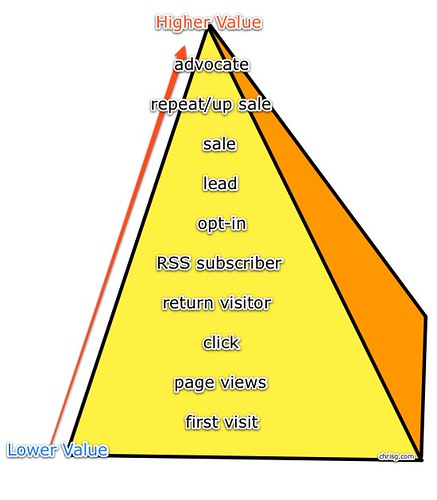
    Web Metric Value Pyramid

    Traffic

    As you can see, when dealing with CPM (page impression based ads), you are only concerned with the bottom two rungs, visits and page views. They are the easiest to obtain and therefore the lowest value. Your visitor here doesn’t need to like what they see and might have been tricked into visiting. Traffic is not a sign of quality.

    Click Throughs

    Next up is the clicks. If you make money from Adsense or other pay per click ads, this is where you spend your effort. You might also try to get many clicks as a way of influencing other webmasters. When people see a site in their referrers generating a lot of traffic they tend to take notice.

    Another value to take from clicks is if you deal with a wide appeal affiliate merchant like eBay or Amazon. Those clicks can eventually turn into sales but the selling is not your problem, all you need to do is drop that affiliate cookie onto the visitors browser and the merchant does all the hard work.

    Again, clicks are not a sign of quality. The visitor might be just wanting to get away, to anywhere but here. In fact, many Adsense webmasters count on just that.

    Loyal Readers

    Now we are in the zone where a blogger or webmaster has to earn their money. You don’t get return visits, or subscribers without offering some value. Even more true with opt-ins as the visitor needs to trust you not to spam them or pass on the list to someone else who will. Up until this point you could have been automating, spamming and churning out pages by the thousand with not a care for quality.

    When you want people to return, that is when you need to get serious about your content.

    You need to concentrate on not just demonstrating value on the first visit, but showing enough promise that there will be value in future for them to give you another try. Hopefully you will do a good enough job that they will keep checking in on you and turn into loyal readers.

    Leads and Sales

    You will have no doubt heard many times that “the value is in the list”, and it is broadly true. If you get a lot of people to want to hear from you on a regular basis, more importantly if you have an engaged audience, then you should be able to make sales.

    A number of times you will have read me say that I would rather have a smaller and more engaged readership, and now you know why. Across the properties I own, part own, write for or work with, I have access to millions of page views. I would give all those page views up for ten people who really want to hear from me. Just think about that for a second. Wouldn’t you?

    Unlike many bloggers, my mortgage gets paid when people believe in me enough that they seek my advice on blogging, new media and internet marketing. I love to see a Digg front page as much as the next guy, and there is a certain value in that, but if people just click or view pages then my bills don’t get paid.

    To make a sale, and even more to get repeat sales, you have to step right up and show real value and engender enough trust to overcome the very significant objections of doing business over the internet. You have to show that not only is your product or service worth the money, but that you can be trusted to deliver what you promised.

    Plus of course you have to ask for the sale.

    Loyal Customers and Fans

    When you deliver on your promise, then you have a chance at repeat custom. Even better,  if you delight your customer, you might just get a fan or two.

    In order to do this your customer must experience your product or service in the most positive way possible. You are not merely delivering a package and saying “bye bye”. That product has to more than meet expectations, be more than just “worth what was paid for”. The customer needs to reap the benefits of what they were sold.

    This isn’t always possible, it’s not a perfect world, but you must try. The pay off is someone who will forever sing your praises, and the value of someone willing to tell the world how great you are is beyond measure.

    Summary

    When you are thinking about what you are doing online, do not be content with merely attracting traffic and gaining some clicks. The real value is in the relationships, the trust and the actual value you can create. Are you truly helping people or are you just going through the motions and writing the appropriate keywords?

    It might be with a smaller audience you create more value for both you and your audience. Worth considering, right?