Calming the Shipping Chaos
Right now as I type this many of us are bracing ourselves for the busiest ecommerce time of the year. It’s nearly that “Black Friday and the Holidays” period where things go from the usual day-to-day to OMG PANIC.
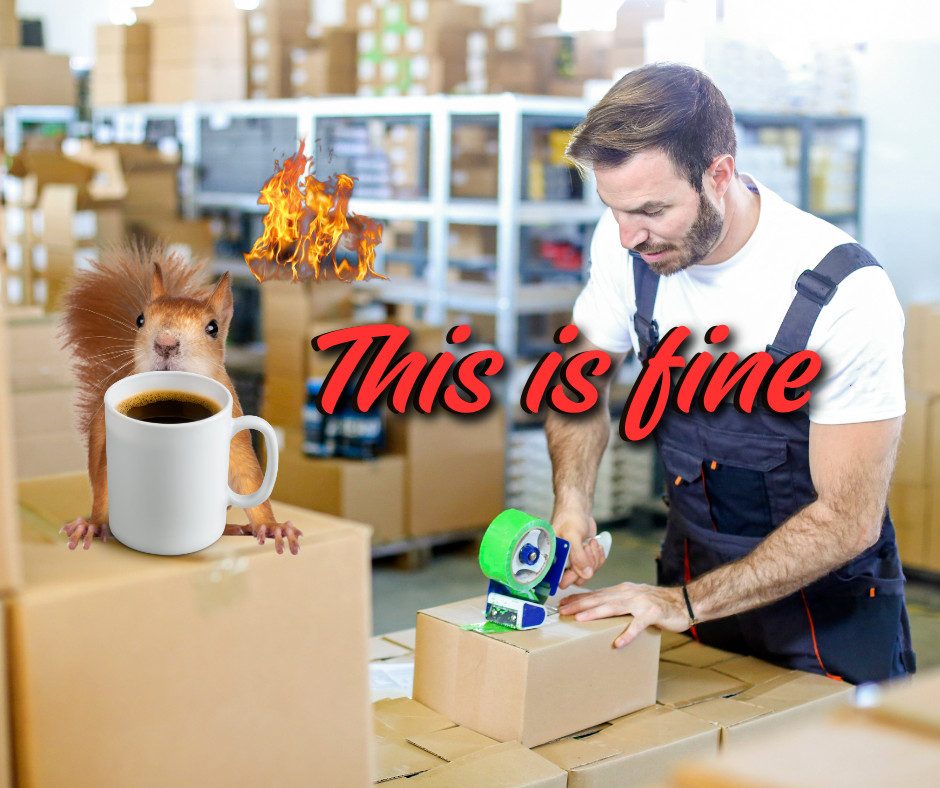
If even on your best days your shipping currently feels like an overly-caffeinated squirrel is running it then welcome to the club, you’re in good company.
Every growing business eventually reaches the moment where shipping gets messy, inventory pulls a disappearing act, and the warehouse starts looking like a cross between a cardboard city and a stress-induced obstacle course.
But before you start Googling “remote cabin in the woods, no wifi,” let’s chat. Chaos doesn’t mean you’re failing; it means you’re scaling, evolving, and hitting the point where systems and strategy finally matter more than flop sweat and sticky notes.

So take a deep breath. Step away from the panic button. And let’s reset your logistics back to smooth, smart, and downright impressive.
When Everything Feels On Fire
Want to know if your logistics really are in chaos? Sometimes it feels that way, but actually you’re getting most things right, and you’re just stressed out, but other times…well, the chaos is real and you really do need to do something about it.
Warning signs include:
- Orders always need to go out yesterday
- Your inventory count is… let’s call it “interpretive”
- Staff are basically playing hide-and-seek with products
- Someone just put perishables next to packing peanuts
- You’ve asked “who put this here?” about 48 times today
- There’s a random beeping somewhere and it’s stressing you out
But here’s the good news: chaos means opportunity. It means you’re moving fast, now you just need to move smart.
Get Your Workflow Right
Logistics lives and dies on flow by which we mean the movement of goods, data, and communication. When flow breaks, chaos blooms like week-old bread in a humid warehouse corner.
Ask yourself:
- Do products move logically from receiving ? storage ? picking ? packing ? shipping?
- Or does everything feel like a scavenger hunt?
You don’t need a fancy consultant. Start simple:
- Put fast-moving stock close to packing
- Label literally everything
- Create clear travel paths
A clean, directional flow reduces errors, stress, and demand for ninja moves.
Systemise or Suffer
Chaos often shows up when business outgrows spreadsheets and memory-based systems.
If your order management system has been nicknamed “that effing computer” because it argues with you and ruins your day, it’s time for an upgrade.
When you go from a stack of boxes to having a real warehouse then start to look for tools that help:
- Track inventory in real time
- Automate pick lists
- Provide barcode scanning
- Integrate with shipping carriers
- Forecast demand instead of guessing
For larger operations you will need extra help. It could be a fresh pair of eyes, or it could be a specialist such as a NetSuite WMS Consultant who can implement real warehouse management strategy.
The main thing is growth requires proper organisation, not the “hope and hustle” approach we all start out by Frankensteining together.
Train Like You Mean It
If the only sort of training you have is to tell your new hires to follow everything Steve is doing because he’s worked there forever and he knows everything, then you are doing it wrong and you need to change it pronto.
Documentation and repeatable processes aren’t boring, they’re life support for logistics. Making the process of documenting your training easy is important and it’s going to make your business stand out – but only if you invest in the right places. Software like ClickLearn is going to help you to elevate your business in the best possible way. With the repeated process of training, you can customize based on what your people need because you have software that can create the documentation for you
Create simple, clear guides for:
- Receiving procedures
- Put-away rules
- Picking and packing standards
- Labeling and scanning steps
- Shipping workflows
The goal isn’t perfection, it’s consistency over chaos.
And hey, make the training fun. Gamify picking accuracy. Celebrate zero-error days. Reward efficiency. People love being good at their jobs, so give them the tools they need to be the best they can be.
Build Feedback Loops (Real Ones)
Most logistics problems are not mysteries – your warehouse team already knows them. They see the inefficiencies, the bottlenecks, the “why on earth are we doing it this way” routines.
But if nobody asks, nobody fixes.
Have quick improvement meetings:
- What slowed us down today?
- What bottlenecks did we see?
- What tool or step wasted the most time?
- What tiny change would make a big difference?
Small changes add up. And logistics isn’t improved with big leaps, rather, it’s fixed with steady nudges.
Mistakes Are Maps, Not Failures
When orders get mis-picked or shipping labels go rogue or inventory counts vanish into a black hole, don’t assume disaster. Assume data.
Every error is a breadcrumb pointing toward a system to improve:
- Wrong item shipped? Check SKU labeling.
- Slow picking times? Fix layout flow.
- Inventory mismatch? Audit receiving process.
Chaos becomes calm when you respond with curiosity instead of drama.
Automate (the Right Stuff)
Automation doesn’t mean replacing people – It means removing the tasks that make them want to scream into packing paper.
Start with:
- Barcode scanning
- Automatic replenishment alerts
- Digital pick tickets
- Batch shipping tools
- Real-time inventory sync across systems
Future-you will want to high-five present-you for every manual task you eliminate.
Automation = fewer mistakes, faster fulfillment, and a logistics operation that doesn’t run on heroics alone.
Cool the Chaos
Logistics chaos affects morale. You can feel it in the air: the tension, the rushing, the “we’re behind again” dread.
Your job is to cool the temperature:
- Celebrate progress, not just speed
- Praise accuracy as much as productivity
- Encourage calm problem-solving
- Give breaks and acknowledge hard work
- Fix systems – don’t blame people
A calm team is an efficient team. A panicked team is a walking error machine.
Bake Resilience Into the System
Chaos doesn’t disappear forever, but you can prepare:
- Cross-train employees so absences don’t break flow
- Document everything
- Maintain clean, organized workspaces
- Keep backup equipment and supplies
- Review systems quarterly (not yearly)
Logistics is like plumbing: if you take the time to fix leaks early, everything flows.
Bottom Line: Calm Logistics Are Built, Not Born
You don’t wake up one day with a flawless supply chain; you build it piece by piece, habit by habit, system by system.
Right now, it may feel messy. But messy means you’re growing. And the moment you start organizing chaos instead of reacting to it?
That’s when logistics becomes a competitive advantage, not a daily battle.
So here’s your mantra going forward:
“We don’t panic, we improve.”
Your warehouse, your customers, and your sanity will thank you.
Now go conquer the chaos, and maybe reward yourself with a coffee that you don’t have to gulp while speed-walking past that one row of wobbly shelving.